
The government has set a direct tax collection target of Rs 13.35 trillion, which includes Rs 7.66 trillion from corporation tax and Rs 5.69 trillion from personal income tax.

The rise in bond yields would make it difficult for banks to pass on rate cuts as except for retail loans, most of their legacy portfolio are linked to marginal cost based lending rate, which takes into consideration bond yields.

Non-banking financial companies, that used to comprise at least 70 per cent of the issuance in the corporate bond market, are witnessing a credit freeze as investors shun bond issued by lower-rated firms.

The Malegam committee on the RBI's capital adequacy had suggested that the RBI must move away from its methodology to calculate the foreign exchange gains to a weighted average cost-based valuation method. Central bank may done away with provisioning requirements, to enable higher transfer of surplus in the 2017-18 fiscal, analysts say.

All public sector banks have moved to such a regime voluntarily, while private banks are yet to. The state-run banks have introduced repo-linked products for floating-rate home and auto loans, but the RBI said loans to micro, small and medium enterprises (MSMEs) should also be linked to an external benchmark.
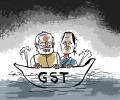
The collections stood at Rs 98,202 crore in the month, against Rs 1.02 trillion in July. The figures indicate continuation of economic slow down which was reflected in the gross domestic product (GDP) growth which plummeted to a 25-quarter low of 5 per cent in the first quarter of 2019-20, experts said.

The Jan-Dhan accounts are zero balance accounts, comes with a life cover of Rs 30,000 per person, and an accidental cover of Rs 100,000. An active user of the account can also get overdraft facility of Rs 5,000 from banks.

DTC task force also favoured doing away with Dividend Distribution Tax by suggesting taxing dividends in the hands of shareholders.

The RBI governor's assurance should give investors enough confidence to start believing in the NBFC sector again, say bankers.

Sources in the Fifteenth Finance Commission said that they will implement the provisions after the bill is enacted and the President makes a reference to it.

Digital commerce operators advertising on global social media, which earlier did not pay Google tax on their operations in Jammu & Kashmir, may now have to cough it up at 6 per cent.

Reserve Bank of India Governor Shaktikanta Das tells Anup Roy, Raghu Mohan and Niraj Bhatt that it is time for banks to lower interest rates and start lending to cash-starved finance companies after due credit appraisal and proper risk assessment.
By no means do economists see the Reserve Bank of India stop at just a 25-bp cut. Some of the economists such as Soumyakanti Ghosh of State Bank of India are of the firm view that rates have room to fall by a total of 75 bps in the current financial year, starting with 25 bps in the August 7 policy.

According to data compiled by the World Bank, the UK's economy grew to $2.82 trillion and the French economy expanded to $2.78 trillion in 2018, against India's $2.73 trillion, showed the data.

The Centre's revenue from GST registered a decline of 10 per cent in 2017-18 compared to revenue of subsumed taxes in 2016-17.

Apart from easing the NPA pressure on domestic banks, the RBI's move can allow companies to raise cheap, long-term loans easily now.

With less than five months left for the report of the Fifteenth Finance Commission to be submitted, its chairman N K Singh said the report will have fiscal road map for states, depending on their current situation.

However, the World Bank has projected India's GDP growth rate at 7.5 per cent for the next three financial years, including the current one.

Vodafone Idea, the promoter of Aditya Bira Idea Payments Bank, said in a notification to the exchanges late on Friday that the board of the bank approved winding up the business, subject to approval from the Reserve Bank of India.

A query has been raised about the "missing" Rs 1.7 trillion fiscal hole in India's financial accounts. This is so because the Budget uses the revised estimates, a projection of how much the government was expected to earn, while the Economic Survey uses the first actual numbers.
 © 2026 Rediff.com - Investor Information - Advertise with us - Disclaimer - Privacy Policy - Sitemap - Feedback - About us - Terms of use - Grievances